Originally published in The Voice of San Francisco in January 2026
Haines presents its second solo exhibition with renowned photographer Chris McCaw, Reversals and Revolutions. McCaw expands the possibilities of analog photography practices through his inventive forms that explore essential components – light and time, lenses and light sensitive materials – to generate startlingly inventive pictures. Reversals and Revolutions introduces the artist’s newest body of work, Inverse, alongside a selection of his signature Sunburn prints. Opening during SF Art Week, this highly anticipated exhibition is McCaw’s first solo showing in San Francisco in nearly a decade.
Chris McCaw was born in 1971, and lives in Pacifica, CA. He’s had his hands wet in the darkroom since the age of 13, merging his personal life and photographic life through a constant state of production. He still builds his own cameras, and is currently manipulating the mechanics of how cameras record time.
The Inverse Series
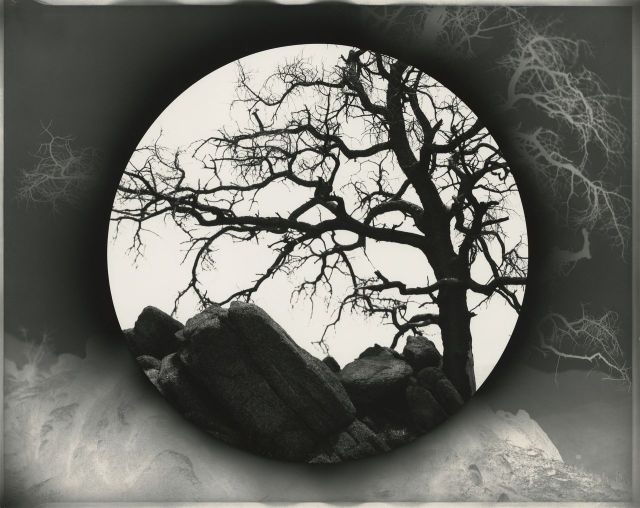
Our photoreceptors turn light into signs via the human eye. Perception can sometimes chain us to the expected, the predictable, and our own set of assumptions about the world. The Inverse series reveals overlapping realities existing simultaneously using solarization techniques. The process of in-camera solarization is achieved through a tonal reversal between negative and positive, caused by overexposure and achieved only through analog means. With his handmade cameras, McCaw utilizes this complex photographic process to compose bifurcated landscapes that disrupt our expectations. In Inverse 117 (Burnt, Anza Borrego), 2025, a bright circle outlines dark, gnarled, leafless tree branches growing out of jagged rocks. Around its perimeter, ghostly branch tendrils float in dark grey. The circle’s shape suggests something planetary, perhaps the sun itself. The circle is also an eye, a peep-hole, and a binocular exposing the night vision of the tree to daylight.
The negative and positive can serve as visual metaphors for how we see the landscape and navigate its changing manifestations. In Inverse 104 (Face of El Capitan), 2024, the positive area is again framed within a central oculus. The viewer trains their eye on a close-up detail, in this case, the rocky surface of a faraway mountainside. The orb contains another surprising point of view, and can also be regarded as a massive floating planetary rock surrounded by a dark-grey aura, levitating in front of the mountain. The viewer sees, but in another story the floating image watches us, too.
The Sunburn Series
McCaw’s iconic Sunburn works present one-of-a-kind photographic objects that are literally drawn with light. In this series, the sun is both the subject, the instrument, and an unpredictable collaborator. The high-powered lenses of his handmade cameras harness the power of the sun, allowing it to burn its path across light sensitive paper loaded directly into the camera. The artist decides the exposure time, lasting anywhere between several seconds to entire days, and the sun renders its own presence as circular burns or searing arcs over the horizon.
Reversals and Revolutions includes an array of technically ambitions Sunburn works in which the solar incisions are scorched across multiple panels during sequential exposures or arrangements in cartographic grids. The results are carefully planned interactions with chance. McCaw travels to locations based on the angle and power of the sun at a particular time of year, composing images that trace the sun’s unbroken path from evening till morning in the Alaskan summer, for example, when the sun never sets below the horizon. McCaw also captured the vertical ascent of the sun in the Galapagos, near the equator. Earth’s rotation and passage of time are made material, and the places chosen provide the sun with an opportunity to make a different location-based statement on paper.
Sunburned GSP #1155 (Eastern Sierras), 2025, is a seven-panel work showing the sun’s path from sunrise to sunset. The muted tones of the landscape are interrupted by the darkness of the arc in the sky burned in the paper. It nearly resembles a crude pencil line until, upon closer view, the burn marks of the sun are evident on the paper. The dark lines between the paper panels provide another level of contrast and interruption. Sunburned GSP #1131 (San Francisco Bay), 2024 consists of twelve unique gelatin silver paper negatives. The sun’s travel over the surface appears as a shooting star over the bay represented in muted greys inside a collection of squares reminiscent of multiples and pop art. Sunburned GSP #1150 (Galapagos), 2012 is perhaps the most abstract and dramatic work in this series. Two nearly-black panels arranged vertically are bisected by a bright slash representing the sun’s vertical ascension into the sky, the ground below suggested in somber hues. The burn marks sit in contrast to the dark background in beautiful browns, greys and white.
Reversals and Revolutions offers a meditation on the natural world and analog photography’s continued capacity for reinvention. Chris McCaw’s experimental rigor pushes the photography medium beyond conventions into experimental and symbolic areas normally associated with abstract art. The exhibition underscores McCaw’s role as one of contemporary photography’s most inventive practitioners, inviting viewers to reconsider the familiar world through processes that are as conceptually rich as they are visually arresting.